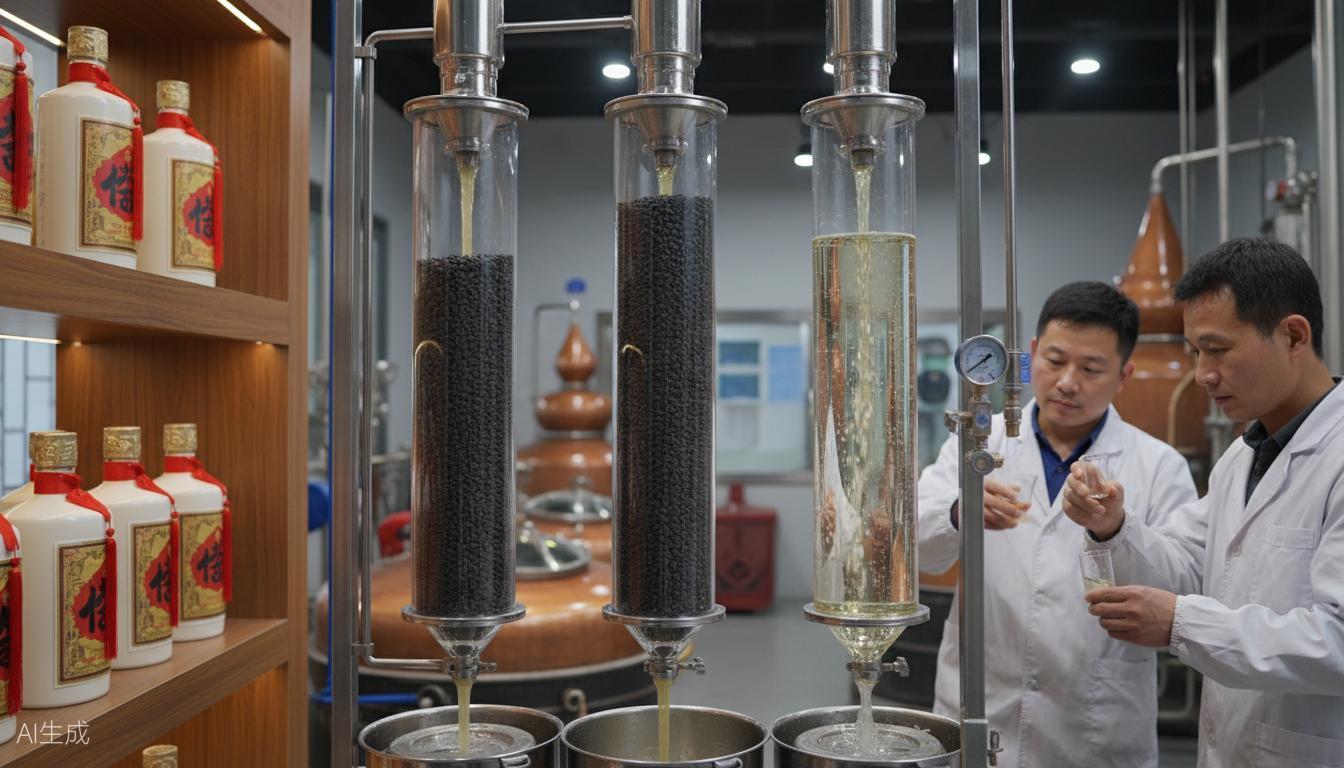
When Chinese baijiu is proofed down from around 52% to 38–42% ABV, the higher fatty acid ethyl esters (ethyl palmitate, ethyl oleate, ethyl linoleate) lose solubility at low temperature and form white flocculent precipitate, spoiling appearance. Activated-carbon haze removal is the industry-standard process. How does bamboo activated carbon compare with coconut-shell carbon on haze removal and aroma retention?
Core requirements for baijiu haze removal
An ideal haze-removal activated carbon needs: high removal rate for higher fatty acid ethyl esters (above 90%); low adsorption of baijiu aroma compounds such as esters, alcohols, and acids (below 15%); no off-flavor introduction; and compliance with food-contact safety standards. This requires good adsorption selectivity.
Bamboo vs coconut-shell carbon for haze removal
| Parameter | Bamboo carbon | Coconut-shell carbon |
|---|---|---|
| Iodine value (mg/g) | 1,050 | 1,100 |
| Methylene blue (mg/g) | 180 | 200 |
| Ethyl palmitate removal (%) | 92.5 | 94.8 |
| Ethyl oleate removal (%) | 88.3 | 91.2 |
| Total ester retention (%) | 88.5 | 85.2 |
| Total acid retention (%) | 95.2 | 93.8 |
| Ethyl acetate loss (%) | 8.5 | 12.3 |
| Off-flavor introduction | Very slight (bamboo note) | None |
| Price (CNY/kg) | ¥8 | ¥15 |
Data analysis
Bamboo carbon haze-removal efficiency is slightly lower than coconut-shell carbon (ethyl palmitate removal 92.5% vs 94.8%), but aroma-compound retention is better: total ester retention 88.5% vs 85.2%, ethyl acetate loss 8.5% vs 12.3%. This is due to bamboo carbon pore-structure distribution: the higher mesopore proportion provides good adsorption of larger fatty acid esters while adsorbing less small-molecule aroma compounds such as ethyl acetate.
The bamboo aroma: benefit or drawback?
Baijiu treated with bamboo carbon may carry a very slight bamboo note. This could be a positive for products positioned as bamboo-themed concepts, but may be regarded as an off-note in traditional baijiu. Solutions include: using bamboo carbon activated above 900 °C to minimize aroma; or applying a second fine-filtration pass with a small amount (0.1–0.3 kg per ton) of coconut-shell carbon to remove residual notes.
Economic analysis
| Item | Coconut-shell carbon | Bamboo carbon |
|---|---|---|
| Carbon dosage (kg/ton baijiu) | 0.8 | 1.0 |
| Carbon cost (CNY/ton baijiu) | ¥12 | ¥8 |
| Haze-removal pass rate | 98% | 95% |
| Aroma score (out of 100) | 92 | 90 |
| Total cost (CNY/ton baijiu) | ¥12 | ¥8 + ¥2 cleanup = ¥10 |
Need bamboo activated carbon for baijiu haze-removal testing? We can provide different iodine-value grades and help with haze-removal and aroma-retention evaluation.
Request Quote