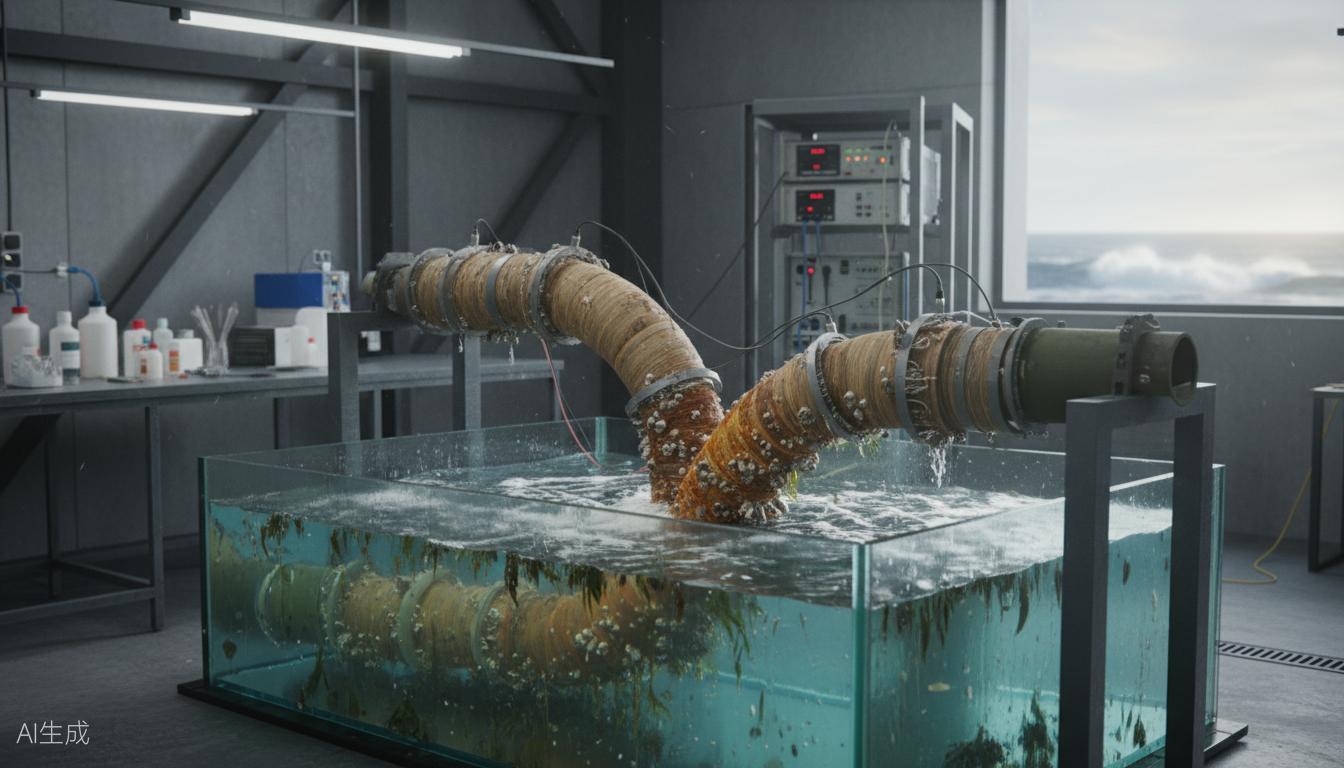
Coastal municipal pipe faces severe high-salt corrosion. In Xiamen, annual average relative humidity is 75–85% and sea-salt deposition is about 10–20 mg/m² per day — tough on both metal and non-metal pipe. This article reports two-year natural-exposure test results for bamboo winding pipe on the Xiamen coastline.
Test plan
| Parameter | Value |
|---|---|
| Site | 50 m from Xiamen Haicang coastline |
| Specimen | DN300, SN8000, 1.0 MPa |
| Exposure | 45° south-facing, natural exposure |
| Control samples | Same-spec HDPE pipe, FRP pipe |
| Inspection cycle | Every 3 months |
| Tests performed | Appearance, Barcol hardness, ring stiffness, resin content |
Two-year exposure results
| Test item | Initial | 12 months | 24 months | Change |
|---|---|---|---|---|
| Appearance | Sound | Slight surface chalking | Chalking + fine cracks | — |
| Barcol hardness | 52 | 48 | 44 | -15% |
| Ring stiffness (N/m²) | 8,500 | 8,100 | 7,650 | -10% |
| Resin content (%) | 38.5 | 36.2 | 33.8 | -12% |
| Mass loss (%) | — | 1.2 | 2.8 | — |
| Surface water absorption (%) | 0.35 | 0.52 | 0.68 | +94% |
Comparison with control samples
| Item | Bamboo winding | HDPE | FRP |
|---|---|---|---|
| 24-month ring stiffness retention | 90% | 98% | 88% |
| 24-month appearance | Chalking + micro cracks | Nearly unchanged | Chalking + fading |
| Salt-spray resistance | Good | More stable typically | Moderate |
| Biological attachment | Slight algae | More barnacle attachment | More algae |
| Expected coastal life | 25–30 years | 40–50 years | 20–25 years |
Corrosion mechanism
Aging of bamboo winding pipe in coastal environments is mainly a combination of UV degradation and surface hydrolysis of the resin matrix. Sea-salt particles accelerate hydrolysis through a salt-catalytic effect. Bamboo winding pipe has a higher resin content (35–40%) than FRP (25–30%), giving it slightly better corrosion resistance. HDPE, containing no natural fiber, has the best salt-spray resistance but much lower ring stiffness at equal weight.
Coastal application recommendations
- Apply UV-protective and anti-fouling coating to the outer surface (expected life extension to 35–40 years).
- Buried sections face no difference from inland conditions — design normally.
- Intertidal zones (wetting-drying cycles) suffer the worst corrosion and need special protection.
- Avoid direct contact with dissimilar metals to prevent galvanic corrosion.
- Suggested design life: 25–30 years for exposed coastal sections, 40–50 years for buried sections.
Need coastal corrosion-protection solutions for bamboo winding pipe? We can provide anti-fouling coatings, UV protection, and on-site technical support.
Request Quote