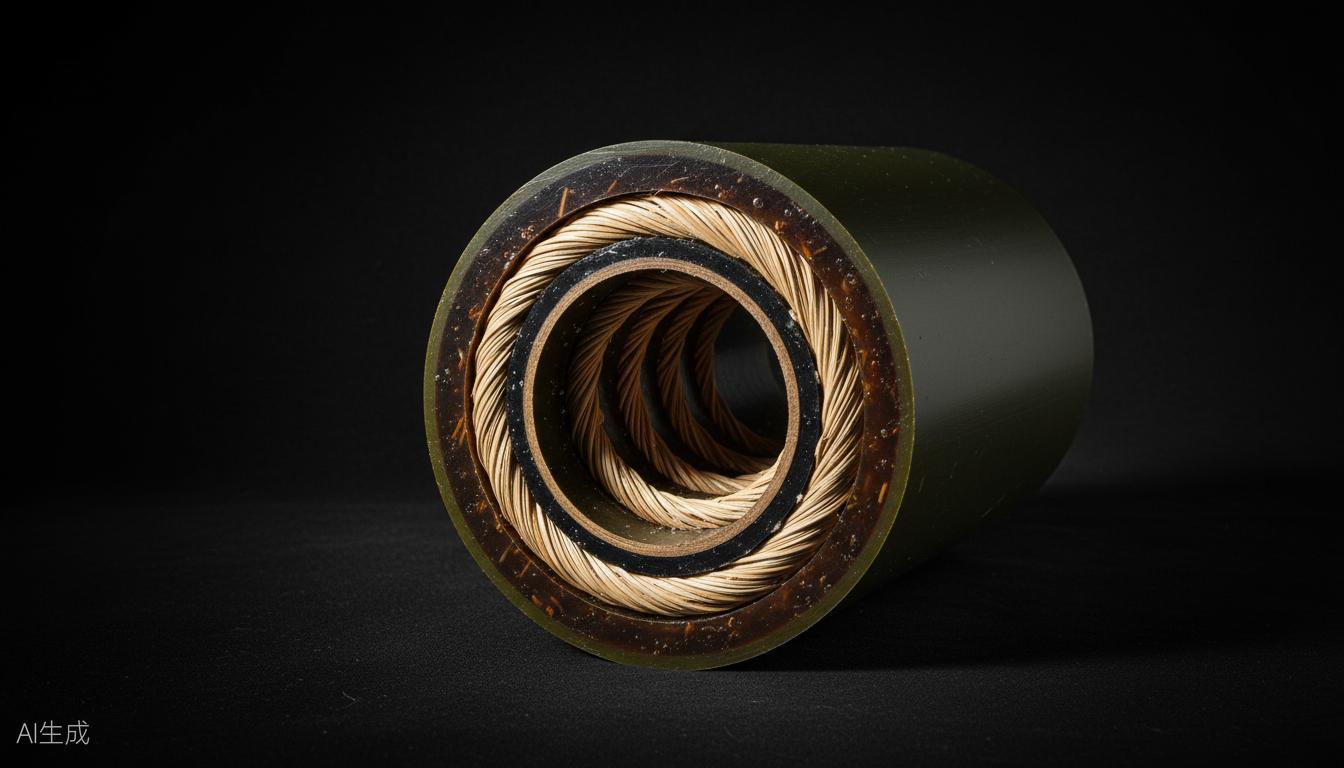
Bamboo winding composite pipe claims a 50-year design life. Where does this number come from? This article explains the 10,000-hour hydrostatic test principle, extrapolation method, and real-world limitations.
How the 10,000-hour hydrostatic test works
The test is based on the stress-life (S-N) curve principle. Multiple pipe samples are subjected to different constant internal pressures, and failure times are recorded. The longest test runs 10,000 hours (about 417 days). Using log-log regression, the S-N curve is extrapolated to 438,000 hours (50 years) to derive the allowable working pressure. Typically eight sets of samples are tested at eight different pressure levels.
Test parameters
| Parameter | Value |
|---|---|
| Standard | GB/T 21238-2007 (FRPM pipe, used by reference) |
| Test specimens | DN200 and DN300, pressure class 1.0 MPa |
| Sample count | 2 groups × 8 levels × 3 pipes = 48 pipes |
| Longest test duration | 10,000 hours (~417 days) |
| Extrapolation target | 438,000 hours (50 years) |
| Predicted capacity at 50 yr | 75% of initial strength (25% drop) |
| Safety factor | 1.5× working pressure (design requirement) |
Is the scientific basis adequate?
The 10,000-hour hydrostatic extrapolation is an accepted method in the pipe industry, used by both FRPM and PE pipe for 50-year life verification. Bamboo winding pipe shares the same thermoset resin matrix as FRPM, making the test method comparable. However, several limitations exist: the test is conducted at a constant 20 °C while real-world temperature cycles accelerate aging; test water is deionized while actual water contains chlorine and other compounds; and the test does not account for construction damage or soil stress.
Real-world life-influencing factors
- Water temperature: sustained above 40 °C accelerates resin aging; reduce estimated life by 20–30%.
- Chlorine in water: residual chlorine above 1 mg/L may degrade resin; inner anti-corrosion lining recommended.
- UV exposure: above-ground sections need UV-protective coating; otherwise surface resin embrittles within 5–8 years.
- Construction quality: poor joint sealing is the leading cause of premature failure.
- Ground settlement: uneven settlement creates bending stress concentrations.
- External loading: insufficient burial depth or traffic overload causes excessive hoop stress.
Comparison with HDPE life verification
| Item | Bamboo winding | HDPE |
|---|---|---|
| Design life | 50 years | 50 years |
| Verification method | 10,000 h hydrostatic | Creep extrapolation |
| Main aging mechanism | Resin hydrolysis, fiber degradation | Creep, oxidative embrittlement |
| Temperature sensitivity | Moderate-high (resin matrix) | Moderate (creep acceleration) |
| Longest service history | ~15 years (still monitored) | 30+ years |
| Repair convenience | Section replacement needed | Heat-fusion repairable |
The 50-year life prediction for bamboo winding pipe is theoretically sound but lacks long-term service validation. The longest installation history is about 15 years. For projects with a 50-year design requirement, consider bamboo winding pipe for a 20–30-year design scenario (typical for most municipal pipe) or pair it with regular inspection programs.
Need a life assessment for bamboo winding pipe in your project? We can provide the 10,000-hour test report and engineering application advice.
Request Quote