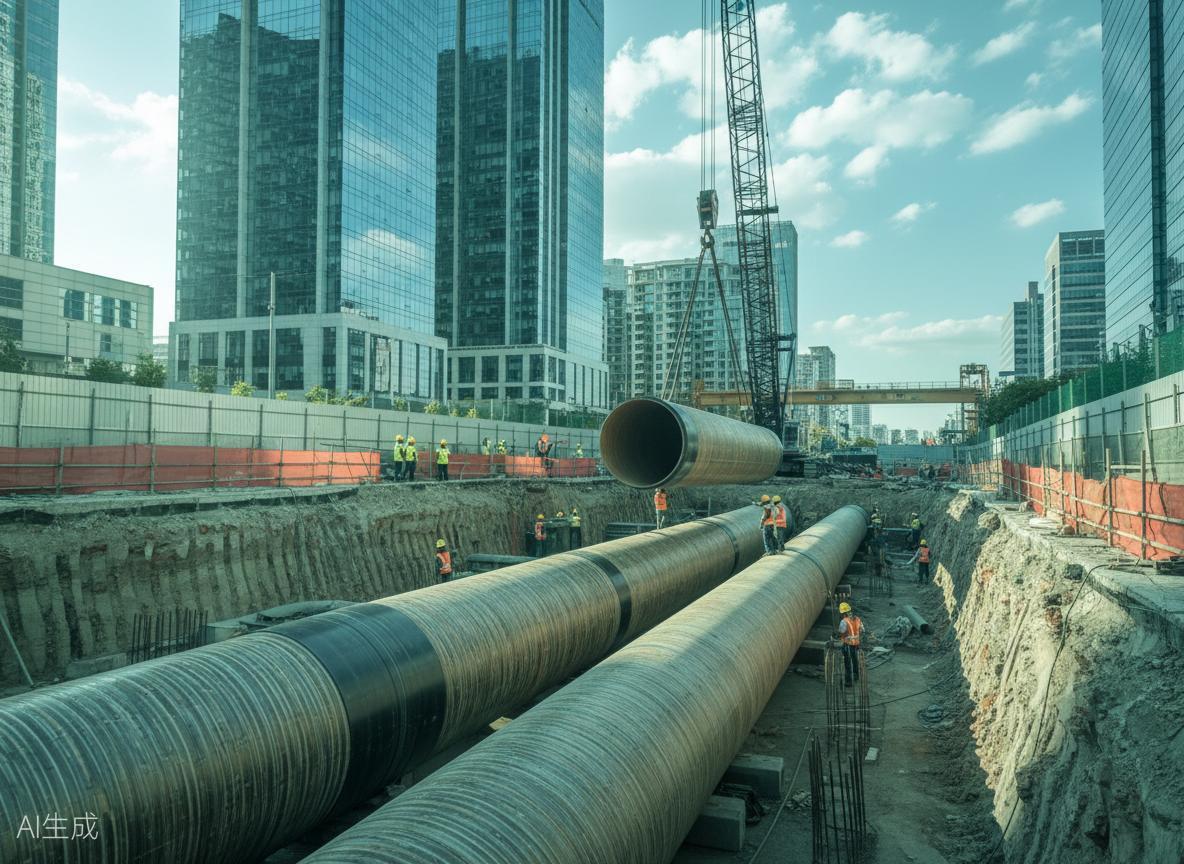
Installation Guide for Bamboo Winding Composite Pipe: From Trenching to Backfill
A step-by-step construction guide covering excavation, bedding, pipe laying, socket connection, hydrostatic testing, and backfill.
Installation quality directly affects the service life and safety of bamboo winding composite pipe. This article provides a complete construction guide from excavation through backfill for DN300–DN2000 municipal water, drainage, and irrigation pipe.
Product quality certificate, third-party test reports, visual inspection
Trench setting-out
Survey and mark centerline and excavation boundaries per design
Equipment preparation
Excavator, crane, cutter, generator, water pump
Personnel training
Installation crew must receive bamboo winding pipe specific training
Trench excavation dimensions
Diameter (DN)
Trench bottom width (m)
Slope ratio
Minimum cover (m)
300–500
OD + 0.6
1:0.3–1:0.5
0.8
600–800
OD + 0.8
1:0.3–1:0.5
1.0
1000–1200
OD + 1.0
1:0.5–1:0.75
1.2
1400–1600
OD + 1.2
1:0.5–1:0.75
1.5
1800–2000
OD + 1.5
1:0.75–1:1.0
1.8
Key precautions: leave the final 20–30 cm for manual trimming to avoid disturbing the natural ground; dewater to 0.5 m below the trench bottom if the water table is high; install sheet piling or additional slope if the trench wall is unstable; stockpile excavated soil at least 1 m away from the trench edge; replace poor ground such as mud or quicksand.
Bedding treatment
Ground condition
Treatment
Thickness
Undisturbed soil, bearing ≥80 kPa
Direct laying
—
Bearing 50–80 kPa
100 mm medium-coarse sand cushion
100 mm
Bearing <50 kPa
200 mm gravel replacement + 100 mm sand cushion
300 mm
Soft clay
Full gravel-soil replacement + sand cushion
500 mm
Socket connection steps
Clean the socket and spigot ends and check the rubber-ring groove.
Insert the rubber ring correctly into the socket groove without twisting.
Lubricate the spigot outer surface with soapy water or a dedicated lubricant.
Use a crane or chain block to push the spigot smoothly into the socket.
Insert to the marked depth (typically two-thirds of the spigot length).
Check that the joint gap is uniform and the pipe axis is aligned.
Hydrostatic testing
Test
Test pressure
Hold time
Pass criteria
Strength test
1.5× working pressure
10 min
No rupture, no leakage
Tightness test
1.25× working pressure
30 min
Pressure drop ≤0.05 MPa
Leakage test
Working pressure
30 min
Leakage ≤ permissible
Backfill
Haunch zone under the pipe: compact medium-coarse sand manually in layers.
Up to 0.5 m above the pipe: use medium-coarse sand or fine soil free of rocks and bricks.
Compact in 200–300 mm layers to at least 90% density.
Above 0.5 m over the pipe: native soil can be used; heavy machinery must not run directly over the pipe.
Backfill symmetrically to avoid uneven lateral loading.
Need on-site installation guidance for bamboo winding pipe? We can provide construction training, field support, and acceptance assistance.
Can bamboo winding pipe be welded like steel pipe?
No. It uses socket-type rubber-ring joints and cannot be welded. The rubber ring provides watertight sealing through elastic compression. For DN800 and above, the joint can be reinforced with an external FRP overwrap.
Can installation proceed in winter?
Yes, but precautions are needed below 5 °C. Rubber rings must be kept warm, low-temperature lubricant must be used, and backfill must be free of frozen soil. It is advisable to pause work when the daily mean temperature falls below 0 °C.
What is the maximum continuous laying length?
Standard single-pipe lengths are 6 m or 12 m. A pipeline can extend hundreds of meters to several kilometers with manholes or junction chambers providing sectional connections. Maximum continuous length depends on terrain and construction conditions.