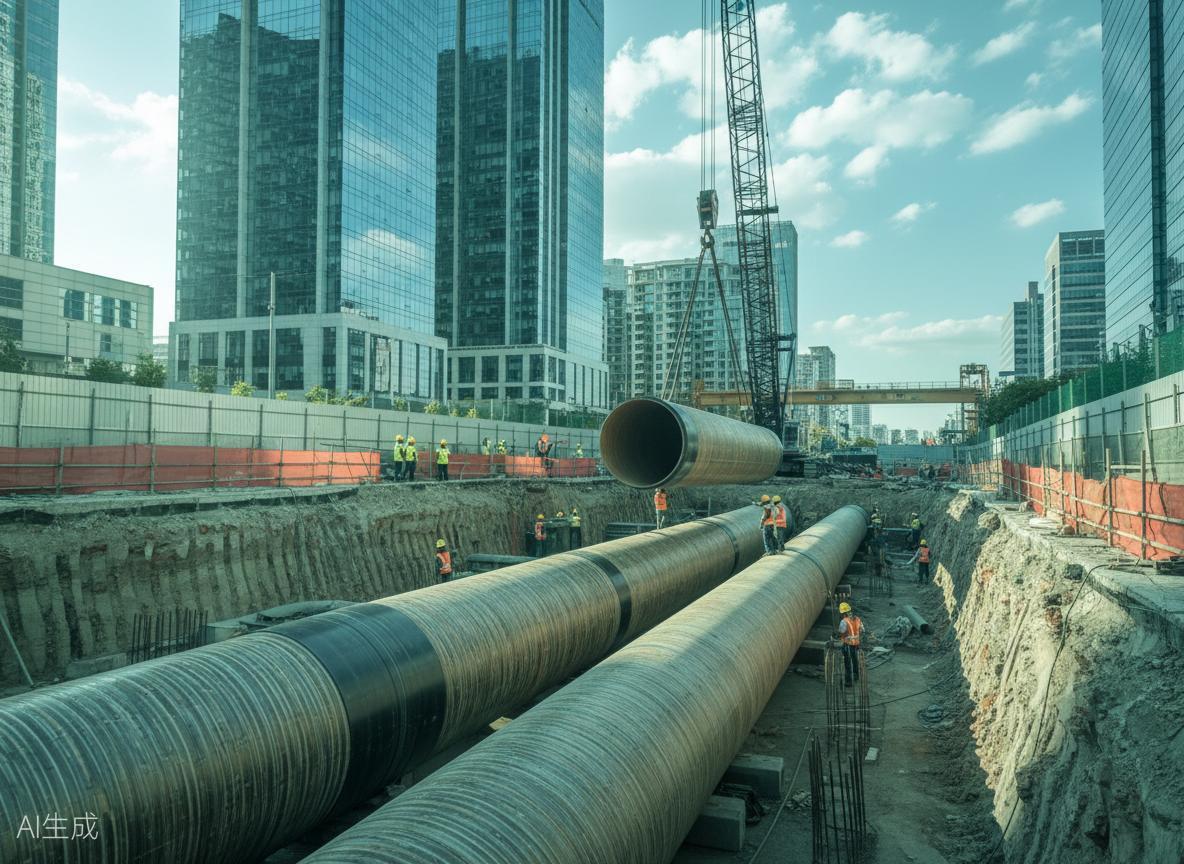
Project acceptance for bamboo winding composite pipe must reference the national standard GB/T 36797-2018 and the specific technical parameters set in the project design documents. Acceptance is divided into three stages: incoming-material inspection, installation-process inspection, and final completion acceptance.
Incoming-material inspection items
| Test item | Method | Acceptance criteria (reference) | Sampling rate |
|---|---|---|---|
| Appearance | Visual | No delamination, no bubbles, no obvious defects | Every pipe |
| Dimensional deviation | Tape/caliper | OD ±1%, length ±20 mm | 5% per batch or at least 3 pipes |
| Wall thickness | Ultrasonic gauge | Not less than 90% of nominal | 5% per batch or at least 3 pipes |
| Barcol hardness | Barcol hardness tester | ≥40 | 3 pipes per batch |
Mechanical property testing (first batch or per batch)
| Test item | Method | Acceptance criteria (reference) |
|---|---|---|
| Ring stiffness | GB/T 9647 | Not less than nominal (e.g., SN5000) |
| Short-term burst pressure | GB/T 6111 | ≥4× nominal pressure |
| Axial tensile strength | GB/T 5349 | ≥80 MPa |
| Hydrostatic leak test | 1.5× nominal pressure, 1 h | No leakage, no damage |
| Interlaminar shear strength | JC/T 552 | ≥8 MPa |
Third-party inspection workflow
It is recommended to engage a CMA/CNAS-accredited third-party lab for acceptance testing. Standard workflow: the supervisor or owner specifies the test requirements and test items; the contractor assists with sampling by cutting specimens on site; samples are sent for testing with project name, station number, and specification labeled; the lab issues a formal report, typically within five to ten working days; results are judged against the standard.
Common issues and handling
- OD undersized: possible mold wear — require the supplier to replace the mold and supply conforming product.
- Ring stiffness below spec: possible insufficient resin content or winding density — reject the batch.
- Delamination or bubbles: serious quality defect — reject the entire batch.
- Leakage found during installation: stop work immediately to determine whether the cause is product quality or installation error.
- Long-term operation: annual inspection focusing on joint sealing and pipe settlement is recommended.
Documentation archive checklist
- Product quality certificate (supplied by manufacturer)
- Third-party test report
- Incoming material acceptance record
- Installation construction record
- Hydrostatic test record
- Completion acceptance report
Need acceptance testing support for bamboo winding pipe? We can assist with acceptance planning, third-party testing arrangements, and technical consultation.
Request Quote