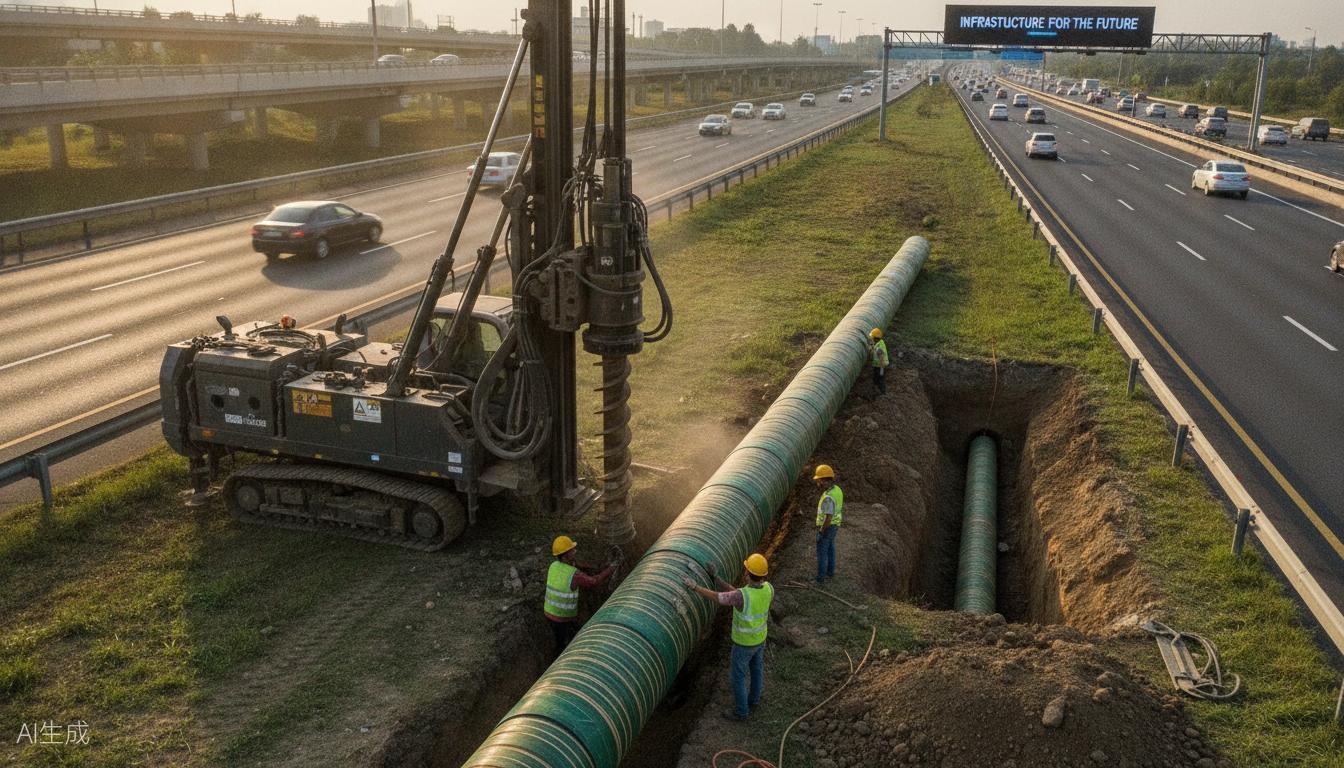
The construction method for bamboo winding composite pipe directly affects project cost and schedule. Crossing different obstacles requires different methods. This article compares HDD, pipe jacking, and open-cut methods with selection guidance.
Three crossing methods compared
| Item | Pipe jacking | HDD | Open-cut |
|---|---|---|---|
| Applicable diameter | DN300–DN3000 | DN100–DN1200 | Unlimited |
| Max crossing length | 200–500 m | 300–1,000 m | Unlimited |
| Ground disturbance | Work pits only | Entry/exit points only | Full-line excavation |
| Traffic impact | Minimal | Minimal | Large (road closure) |
| Accuracy | High (<2 cm) | Medium (<5 cm) | High |
| Unit cost | High | Medium-high | Low |
| Geology limitations | Not suitable for quicksand | Not suitable for cobbles | Unlimited |
| Duration | Long | Medium | Short (without permits) |
Pipe jacking notes for bamboo winding pipe
Key issues: the axial jacking capacity of bamboo winding pipe is limited to about 40–50% that of steel pipe, so keep single-section jacking under 100 m; install steel thrust rings at pipe ends to prevent damage; bentonite slurry lubrication is essential and can reduce friction by 60–70%; maintain jacking speed at 5–10 mm/min to avoid wall damage.
HDD notes for bamboo winding pipe
HDD is the preferred method for crossing rivers and highways with bamboo winding pipe. Key points: bore curvature radius should exceed 150× pipe diameter (e.g., DN600 pipe needs minimum 90 m radius); pullback force must stay under 50% of pipe axial strength with a safety factor of at least 2; fill the pipe with water during pullback to increase stiffness; bore diameter should be 1.2–1.5× the pipe OD for smooth pullback.
Recommended methods by crossing scenario
| Crossing | Recommended | Alternative | Reason |
|---|---|---|---|
| Expressway | HDD | Jacking | No traffic interruption, faster permits |
| Railway | Jacking | HDD | Higher precision, protects roadbed |
| River (<50 m wide) | HDD | Cofferdam open-cut | No riverbed damage |
| River (>100 m wide) | HDD | — | Only feasible option |
| Urban road | HDD or jacking | — | Minimizes traffic impact |
| Greenbelt/farmland | Open-cut | — | Lowest cost, no permits |
Case study: HDD under a national highway
In a Zhejiang municipal project, DN800 bamboo winding pipe needed to cross the G104 national highway (six lanes, 30,000 vehicles per day). HDD was used with a 10° entry angle and 8° exit angle, crossing length 156 m, maximum depth 12 m. Peak pullback force was 85 kN (within safe limits). Total duration was five days with zero traffic impact. Construction cost was about ¥3,200 per meter, approximately 15% lower than steel-pipe HDD due to the lighter pipe weight requiring less pullback force.
Need trenchless crossing solutions for bamboo winding pipe? We can provide jacking and HDD construction design, mechanical calculations, and on-site technical support.
Request Quote