
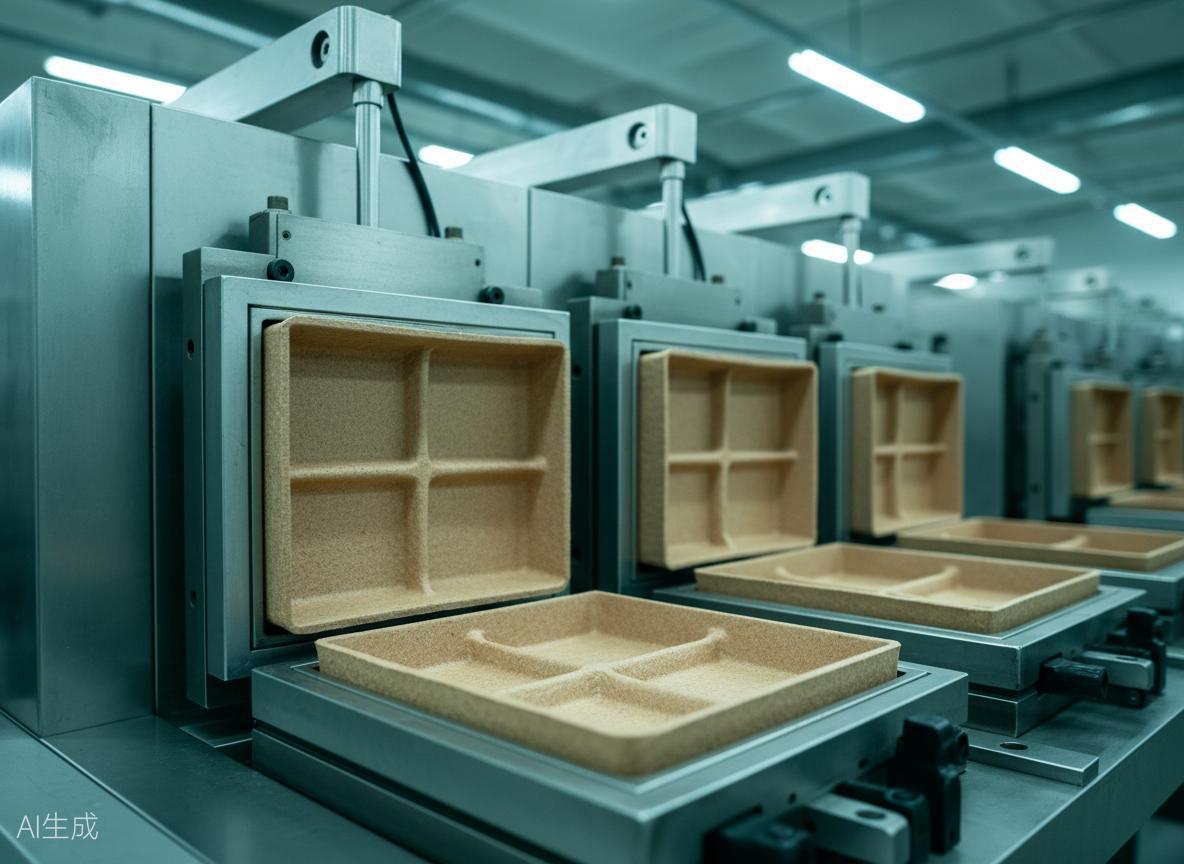
Bamboo molded pulp packaging is manufactured from bamboo pulp fiber through pulping, vacuum forming, drying, and hot pressing. It is now one of the most discussed alternatives to EPS foam and plastic thermoformed trays, especially in electronics, appliance, and food-service packaging projects. The real sourcing question is not whether it sounds greener, but whether it works better across protection, freight, tooling, and compliance.
Material source and compliance position
| Comparison Point | EPS Foam | Bamboo Molded Pulp |
|---|---|---|
| Raw material | Petroleum-based polystyrene | Plant-based bamboo pulp fiber |
| Recycling route | Often limited by local system | Depends on local fiber-recycling and disposal path |
| Biodegradation expectation | Not biodegradable in normal use | Should be judged by formula and disposal environment, not by a generic claim |
| Carbon profile | Fossil-based route | Plant-based route, but still should be assessed case by case |
| Plastic-reduction positioning | Under pressure in some export markets | Often considered in plastic-reduction programs |
Protection performance: where does the real comparison happen?
EPS remains a mature benchmark because of its low weight and good cushioning behavior. Bamboo molded pulp can approach or meet practical protection targets in many projects through rib design, wall-thickness control, and corner reinforcement, but the result always depends on the product weight, outer carton, and transport conditions.
Cost and tooling comparison
| Cost Item | EPS Foam | Bamboo Molded Pulp |
|---|---|---|
| Tooling | Commonly customized and well established | Also customizable, with cost depending on structure complexity and cavity setup |
| Unit price | Often lower | Often higher than EPS |
| Production speed | Usually faster | Moderate, depending on forming and drying route |
| Freight impact | Depends on structure and volume | Can improve through nested stacking and structure optimization |
| Total cost logic | Should include tooling, freight, disposal, and compliance | Should also be judged by landed cost rather than unit price alone |
Where is replacement more realistic?
- More realistic: sub-20 kg consumer electronics, appliance inner trays, and projects under pressure to reduce plastic share.
- Less straightforward: projects requiring transparency, extreme moisture resistance, or exact reuse of an existing EPS structure without redesign.
A safer sourcing sequence
- Request a structure review and sample first.
- Run drop or shipment testing under your own product conditions.
- Check tooling cost against expected volume.
- Confirm destination-market compliance expectations before final launch.
- Start with a smaller validation order before scaling up.
If you want to compare bamboo molded pulp against EPS for your product, send the item dimensions, weight, transport requirement, and target market. That gives a much more reliable basis than comparing materials by description alone.
Request Quote