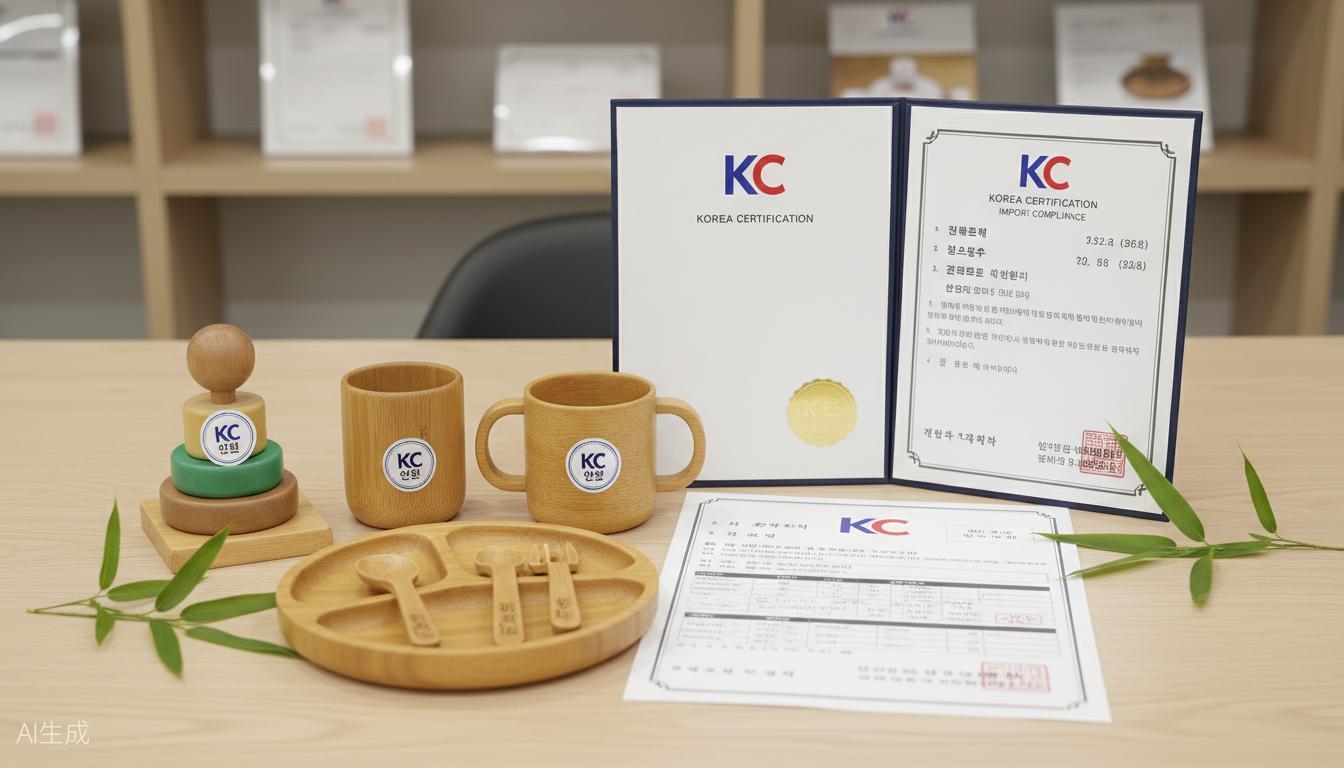
Korea is an important consumer-goods market for bamboo products, especially in kitchenware, tableware, and child-related categories. The practical challenge is that KC is not one single route for every bamboo product. Buyers need to separate children’s products, food-contact containers, adult-use household goods, and nonregulated categories before planning tests or certificates.
Which bamboo products are most likely to trigger KC-related review?
| Product Type | Main Review Direction | Why It Matters |
|---|---|---|
| Children’s tableware or toys | Higher-level child-safety review | Physical safety, chemical limits, and factory-review logic may all matter |
| Food-contact containers | Food-contact conformity route | Migration and hygiene-related review is usually central |
| Adult kitchenware | Category-specific compliance confirmation | The route can be lighter than children’s goods but still needs correct classification |
| Textiles or building materials | Often outside the main KC-mandatory route | Buyers should confirm whether voluntary or quality-mark paths are more relevant |
Why is local importer support so important?
Because in many Korea-market situations, the application and document process need to be handled through a Korean importer or local agent. Foreign exporters often cannot treat the certification flow as a purely offshore paperwork exercise.
What should be checked for child-related bamboo products?
- Physical safety: small-parts, edge, point, and mechanical risk where relevant.
- Chemical safety: heavy metals, phthalates, and other restricted-substance concerns depending on product type.
- Food-contact review if the child-related product also contacts food directly.
- Korean labeling and certificate-use logic after approval.
A practical Korea-market workflow
- Start by classifying the product correctly rather than requesting “KC for bamboo products” in general.
- Confirm whether the project needs mandatory certification, conformity confirmation, or mainly test support and declaration.
- Involve the Korean importer or agent early so the application entity is clear.
- Keep packaging text and material description aligned with the approved scope.
If your bamboo product is intended for Korea, define the end user, age group, and food-contact role first. Those three points usually decide the compliance route much faster than the material name alone.
Request Quote